
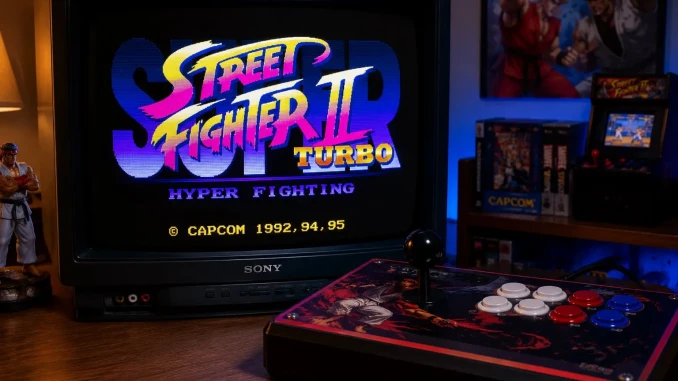
More than three decades after its arcade debut, Super Street Fighter II Turbo continues to be played at tournaments, featured on YouTube channels, and discussed by fighting game veterans as one of the finest competitive games ever created. In a genre now filled with cinematic supers, comeback mechanics, and lengthy combo routes, Super Turbo remains a refreshing reminder that great gameplay does not require unnecessary complexity.
Many players who first discover the game assume it is outdated because of its age. They see short combos, simple graphics, and a relatively small roster compared to today’s fighting games. Spend a few hours actually playing it, however, and that perception quickly changes. Super Turbo rewards precision, strategy, adaptation, and decision-making in ways that very few fighting games have ever matched.
In my opinion, it is still the greatest 2D fighting game ever made, and there are several reasons why.
Simple Controls, Endless Depth
One of Super Turbo’s greatest achievements is how much depth it creates from a surprisingly simple set of mechanics. Every character shares the same six-button layout, there are no universal meters to manage beyond Super, and the rules are easy to understand within minutes.
Mastering those rules, however, can take years.
The game revolves around fundamentals that never become obsolete:
- Footsies
- Spacing
- Anti-air timing
- Charge management
- Punishing mistakes
- Reading your opponent
- Matchup knowledge
- Risk versus reward
Modern fighting games often introduce multiple systems that players must learn before they can even begin understanding neutral. Super Turbo puts neutral at the center of every match from the very beginning. Every step forward, every jump, and every poke has a purpose. There are very few situations where players can rely on mechanics to escape poor decisions.
That simplicity is exactly what makes the game so deep.
Execution Actually Means Something
One criticism often aimed at Super Turbo is that its combos are too short. Compared to today’s games, where 30-hit or 40-hit sequences are common, Super Turbo rarely produces long combo counters.
What many people fail to realize is that short combos do not automatically mean easy execution.
In fact, some of the hardest techniques in fighting game history come from Super Turbo.
Examples include:
- Balrog’s crouching fierce into Super
- Chun-Li’s stored Super confirms
- Guile’s advanced charge timing
- Claw’s wall dive precision
- Dhalsim’s difficult punish conversions
These sequences may only involve a few hits, but landing them consistently requires extraordinary precision. The timing windows are tight, there is little room for error, and tournament pressure makes them even more demanding.
Take Balrog’s crouching fierce into Super. To someone watching casually, it appears to be a simple cancel. Anyone who has actually practiced it knows that executing it consistently is far more difficult than many lengthy modern combo strings.
Execution in Super Turbo is about precision rather than repetition.
That difference makes every successful combo feel earned.
Every Character Feels Unique
Another reason Super Turbo has remained relevant for so many years is its incredible character design.
Every fighter has a clear identity that dramatically changes how the game is played.
Some examples include:
- Guile controls space through patient zoning and defensive play.
- Dhalsim dominates long-range combat with unmatched reach.
- Zangief becomes terrifying once he closes the distance.
- Balrog overwhelms opponents with explosive pressure and devastating punishes.
- Vega (Claw) relies on speed, mobility, and precision.
- Fei Long excels at relentless offense.
- Chun-Li combines outstanding normals and zoning with exceptional movement.
Learning one character is only part of becoming a strong player.
Every matchup presents its own challenges, forcing players to constantly adapt their strategy. A Guile player approaches Dhalsim very differently than they approach Boxer. Zangief requires completely different spacing than Claw. These unique interactions give the game remarkable replay value.
Even after decades of competition, experienced players continue discovering new ideas within familiar matchups.
Neutral Is the Real Battle
Many modern fighting games focus heavily on maximizing damage after landing the first hit.
Super Turbo places equal importance on earning that hit in the first place.
This creates one of the greatest neutral games ever designed.
Small decisions become incredibly important:
- Walking forward at the correct moment
- Standing just outside an opponent’s range
- Baiting anti-airs
- Choosing the correct poke
- Controlling space without overcommitting
- Remaining patient instead of attacking recklessly
Watching high-level Super Turbo can almost resemble a chess match. Players constantly test each other’s reactions while searching for tiny openings. A single mistake often decides an entire round because both competitors understand exactly how dangerous every opportunity can become.
That level of tension rarely disappears, regardless of how many years you’ve played.
Mistakes Have Real Consequences
One characteristic that separates Super Turbo from many newer fighting games is its honesty.
There are very few mechanics designed to rescue players after making poor decisions.
Jump carelessly and you are likely to eat a devastating anti-air.
Throw out an unsafe move and expect a heavy punish.
Lose control of spacing and your opponent immediately gains momentum.
Because mistakes carry genuine consequences, victories feel incredibly satisfying. Players earn success through stronger decision-making instead of relying on comeback mechanics or defensive resources that erase earlier errors.
That philosophy creates a highly competitive environment where improvement feels meaningful.
A Competitive Scene That Refuses to Die
Very few competitive games remain active thirty years after release.
Super Turbo continues to appear at major tournaments around the world because the gameplay remains rewarding. Players still analyze matchups, discover new techniques, and compete at an astonishingly high level.
The community itself deserves enormous credit.
Over the years, dedicated players have:
- Organized tournaments worldwide
- Preserved arcade hardware
- Created detailed strategy guides
- Documented matchup knowledge
- Produced educational videos
- Introduced entirely new generations to the game
Without that passion, Super Turbo could easily have become another forgotten arcade classic.
Instead, it remains one of the most respected fighting games ever made.
Why Modern Players Should Still Try It
If your first fighting game was Street Fighter 6, Guilty Gear Strive, Tekken 8, or another modern title, Super Turbo can initially feel intimidating.
Stick with it.
The game teaches lessons that transfer to virtually every fighting game:
- Better spacing
- Smarter movement
- Stronger defense
- Cleaner execution
- Improved patience
- Better punishment
- More disciplined decision-making
Those skills remain valuable regardless of which fighting game you eventually choose to master.
Many professional players still revisit older Street Fighter titles because the fundamentals they reinforce never go out of style.
Final Thoughts
Every generation believes its newest fighting game represents the peak of the genre. New technology, better graphics, larger budgets, and expanded mechanics certainly make modern games exciting, but none of those features automatically create better gameplay.
Super Street Fighter II Turbo proves that timeless design matters more than spectacle.
Its execution remains demanding. Its characters remain unforgettable. Its neutral game continues to reward intelligent play, and its competitive depth has survived more than three decades of constant scrutiny. Very few games in any genre can claim that kind of longevity.
I’ve played fighting games from nearly every generation, and I always find myself returning to Super Turbo. Not because of nostalgia, but because no other 2D fighter delivers the same combination of tension, precision, strategy, and satisfaction.
For me, Super Street Fighter II Turbo is more than a classic. It remains the gold standard for competitive 2D fighting games, and I believe it still deserves to be called the greatest 2D fighter ever made.